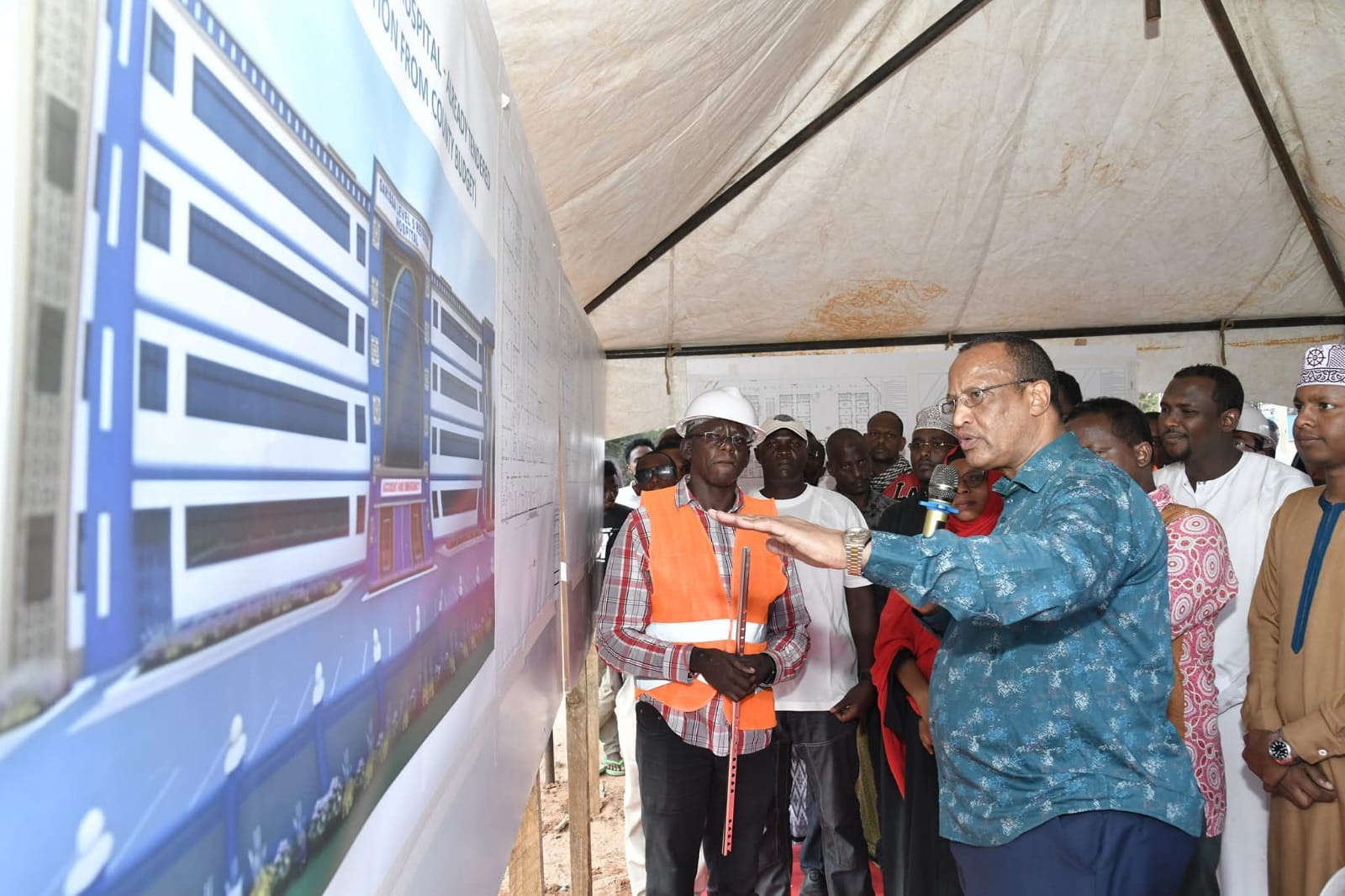
Garissa County is set for a major overhaul of its healthcare system in the implementation of Governor Nathif Jama's plans for a 400-bed Mother and Child Hospital.
The new facility will radically improve maternal and child health outcomes, benefiting communities across the region.
Governor Nathif Jama said his administration had allocated funds for what he described as “one of the most important health investments in a generation,” crediting the project with the potential to ease chronic congestion at Garissa Referral Hospital and reduce preventable deaths among mothers and infants.
“This hospital is not just about expanding infrastructure,” Jama said.
“It is about safeguarding the lives of mothers and children who, for too lon,g have suffered from inadequate access to specialised care.”
The Garissa County Teaching and Referral Hospital Chief Executive Officer (CEO), Mahat Sheikh Salah, said the new 400-bed capacity will transform the county’s strained maternal health services.
Mahat Salah noted that Garissa—like many arid and semi-arid counties—has long grappled with high maternal and neonatal mortality rates.
He attributed this to a combination of limited emergency obstetric services, long distances to fully equipped referral centres, and inadequate critical-care capacity, all of which have left many mothers and newborns vulnerable during medical emergencies.
The head of the biggest hospital in the region said the new facility marks a significant turning point in how maternal and child healthcare is delivered in the region.
The CEO pointed out that the hospital will house dedicated maternity and postnatal wards designed to handle increasing delivery numbers safely and comfortably.
He noted once complete, it will also include modern neonatal intensive care units to support premature and at-risk infants, alongside emergency obstetric and surgical theatres to manage complicated deliveries.
Mahat Salah added that maternal health challenges in Garissa are worsened by the nomadic lifestyle, which limits regular clinic visits and monthly ANC attendance, placing many mothers at high risk.
He noted that widespread malnutrition further weakens both mothers and infants, contributing to poor health outcomes.
He said the current maternity unit, built in 1979, can no longer accommodate the growing demand, often receiving more than 50 mothers in a single night.
The situation is intensified by referrals from the Dadaab refugee complex, which heavily relies on Garissa’s facilities.
Salah described the new project as the county’s biggest health venture—an ultra-modern investment prioritising maternal and child health.
With spacious wards, theatres and improved critical-care units, he said the facility will be a “gamechanger,” forming a key part of Governor Nathif Jama’s health legacy and significantly reducing maternal and child mortality.
Dr. M. Mwema, a policy expert, says health experts believe the expanded capacity will reduce waiting times, improve survival rates for premature infants and mothers with complications.
“It will strengthen the county’s preparedness for emergencies,” he added.
Yunis Dekow, head of press services at the facility, said the project is expected to become the most advanced maternal health facility in the region, reducing reliance on far-off centres in Nairobi and Mombasa.
“Sub-counties such as Dadaab, Balambala, Masalani, Bura and Modogashe—currently dependent on level 4 hospitals—will refer high-risk cases more efficiently,” he said.
Dekow noted that the county has already begun renovating Level 4 facilities across the region and investing in Primary Care Networks.
He described it as essential for linking communities to referral services.
“Beyond health, the project is expected to bring significant economic benefits,” said the Chief of Press Services.
“Construction has generated local employment while the operational phase is likely to attract medical specialists and support businesses around the hospital precinct,” he added.
Dekow framed the investment as part of a broader development agenda of Governor Nathif Jama that includes water projects in drought-hit areas, as well as new agro-processing factories aimed at invigorating rural livelihoods.































Comments
Sign in with Google to comment, reply, and like comments.
Continue with Google